
What Size Storage Building Do I Need? A Charlotte Homeowner's Guide
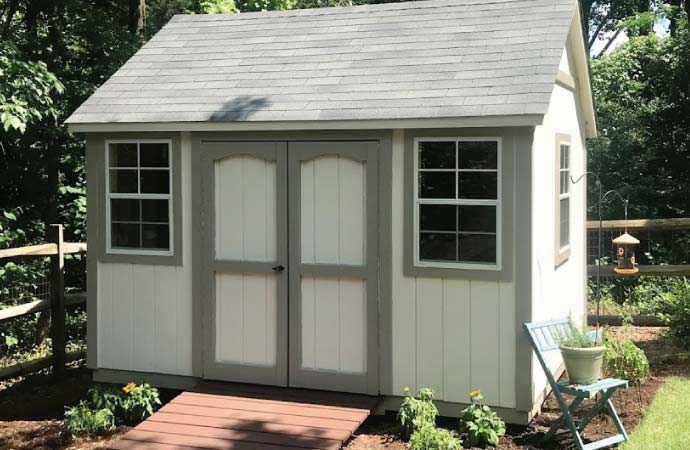
It's the first question almost every customer asks us on the lot: "What size do I need?" The honest answer is that the right size has very little to do with square footage — and everything to do with what you're going to put inside it.
After nearly 30 years of building on-site across the Charlotte metro, we've learned that the people who love their building a year later are the ones who sized it around their stuff and their future — not a number that sounded about right. Here's the simple way we walk customers through it.
1. Start with what you'll store — not the square footage
Walk your garage, carport, basement and patio and make a quick list of the big items that need a home. The footprint of your largest items, plus room to walk around them, is what actually determines your size. A few common starting points:
- Yard & garden: push or riding mower, trimmers, blowers, a wheelbarrow, bags of soil and mulch.
- Garage overflow: bikes, totes, seasonal décor, tools, ladders, a workbench.
- Toys & recreation: a kayak, ATV, golf cart, motorcycle, or a small trailer.
- A room with a job: a workshop, she-shed, home office or hobby space you'll spend time in.
2. Match your list to a size
Once you know your big items, this table covers what most Charlotte-area homeowners end up choosing. Every Fairway building is custom-built, so these are starting points — not the only options.
| Size | Great for | Think of it as… |
|---|---|---|
| 8×8 – 8×12 | Mower, garden tools, bikes, totes | A tidy garden shed beside the house |
| 10×12 – 10×16 | Riding mower + workbench, garage overflow | The popular "get my garage back" size |
| 12×16 – 12×20 | Workshop, she-shed/office, ATV + equipment | A room you can actually work in |
| 12×24 | Trailer, multiple large items, big workshop | A one-car-garage footprint |
| 16×20 – 16×24 | Vehicles, business inventory, serious shops | Garage-class storage |
3. Don't forget the vertical space
Square footage isn't the only way to gain storage. Two choices add a surprising amount of room without a bigger footprint:
- Sidewall height. Taller walls (7' or 8') mean more wall to hang and shelve against, and easier headroom for a workshop.
- A loft. A light- or heavy-duty loft turns the space up under the roof into real storage — ideal for totes and seasonal items. (Our Masters and Pinnacle lines are built around generous loft space.)
4. Check setbacks & HOA rules before you fall in love with a size
This is the step people skip — and it's the one that causes headaches. Before you settle on dimensions:
- Check your property setbacks (how far a structure must sit from property lines) with your county or city.
- If you're in an HOA, look for limits on building size, height, color and placement — many have them.
- Larger buildings may need a permit; thresholds vary by jurisdiction across the Charlotte metro.
It sounds like a lot, but it's usually a quick phone call — and we're happy to point you in the right direction based on where you live.
5. Make sure we can get it to the spot
Because we build on your lot rather than dropping a pre-made box, your building isn't limited by what fits down a road on a trailer. But our crew does need a clear path and a reasonably level spot. A quick look at gate widths, slopes and overhead clearance up front keeps build day smooth.
Not sure? Build it and see the price.
Pick a style and size, add your options, and watch your estimate update live — then send it to us for a firm quote.
Design Your Building →The short version
List your big items, add walking room, glance up (height + loft), and confirm your local rules. When in doubt, size up one. Do that and you'll buy once — and use it for decades, which is rather the point of a building built by hand to last.